Pipeline chaining in Harness
Pipeline chaining involves using the output of one pipeline as input for another. You can link multiple processing steps together and execute them sequentially, creating a more complex workflow.
For example, you could have a pipeline that deploys an application to a test environment. This could be followed by a pipeline that runs a set of integration tests and, finally, a pipeline that deploys the application to production. Each pipeline in the chain is triggered by the completion of the previous pipeline. The output of each pipeline is passed to the next pipeline in the chain. This way, you can automate the whole process and make sure that the application is tested properly before deploying to production.
Chaining pipelines in Harness offers the following benefits:
- Development of complex workflows involving multiple stages of deployment, testing, and verification.
- Ease of handling errors. Visibility into the deployment process makes it easier to identify and troubleshoot issues.
- Faster and more efficient deployment.
- Reusability of the pipeline across multiple applications and environments, reducing the need to recreate the same steps for each deployment.
- Improved collaboration and communication by allowing different teams to work on different stages of the deployment process.
- Enable greater compliance with regulatory requirements and industry best practices through automatic deployments.
Requirements and considerations
- You need read permissions for the child (chained) pipeline and edit permissions for the parent (primary) pipeline to add a chained pipeline (a pipeline stage) to a pipeline.
- To manually run chain pipelines, you need execute permissions for the parent and child pipelines to ensure successful execution.
- If you change the runtime inputs in a chained pipeline, select Inputs in the parent pipeline to see the changes.
- When manually running a pipeline, the pre-flight checks do not validate child pipelines.
- Pipeline stages do not support auto-suggested expressions in Outputs.
- Artifacts, test results, and other output produced by chained pipelines are available in the execution details for the chained pipeline that produced those outputs. This information is not stored in the parent pipeline's execution details.
- Nested pipeline chaining is not supported. When the referred pipeline invokes a child pipeline, it cannot be included within another pipeline.
Chain pipelines
To chain pipelines in Harness:
-
Create each pipeline that you want to chain together, including a parent pipeline where you will link the child pipelines.
-
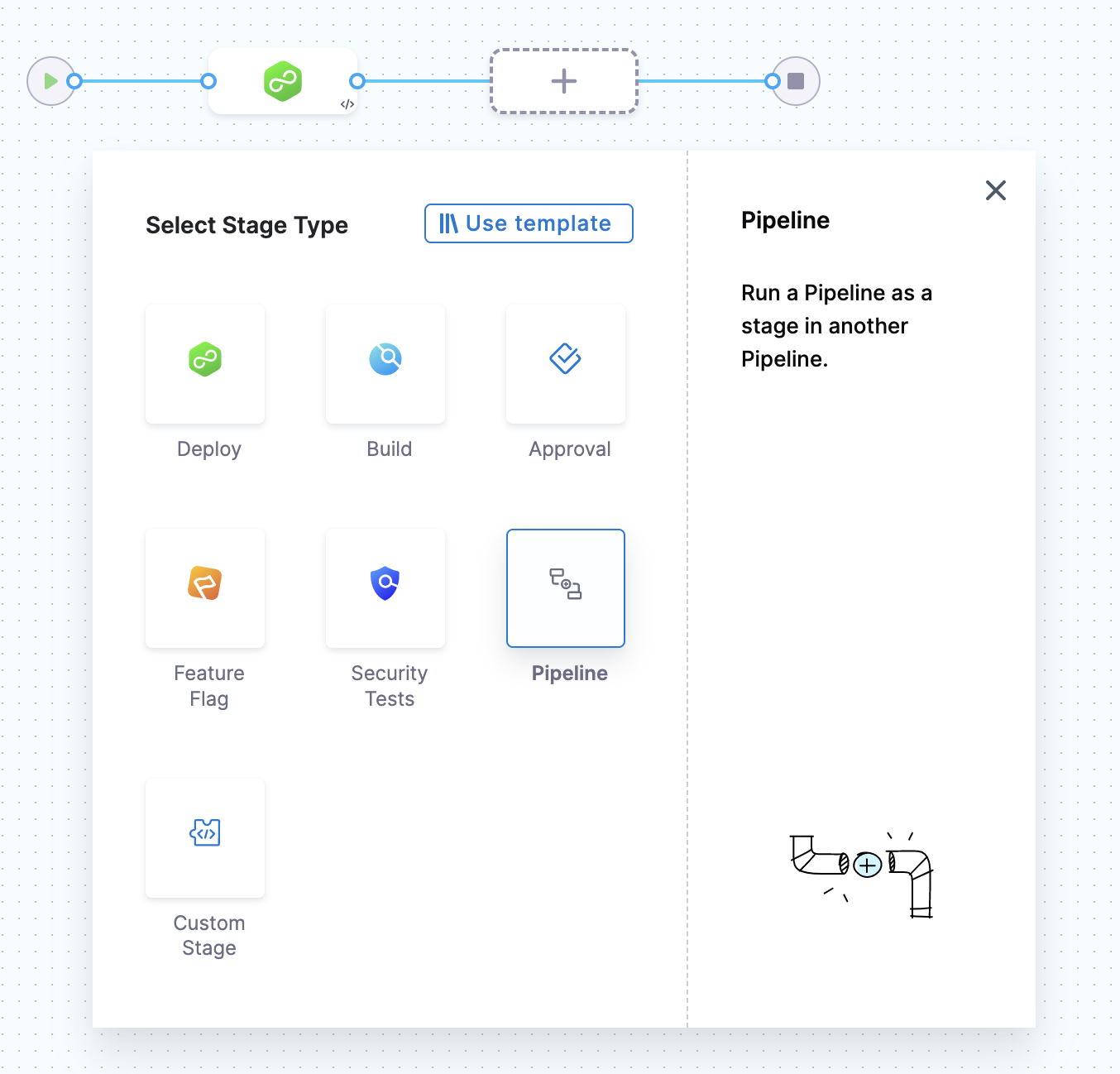
To chain pipelines, go to the parent pipeline, select Add Stage, and then select Pipeline.
-
Select the child pipeline that you want to chain to the parent. You can select any pipeline that you can access across different orgs and projects in your Harness account.
-
Select Apply Selected.
-
Repeat the above steps to continue chaining pipelines as needed, and then save the parent pipeline.
In the final chained pipeline stage, you can add concluding steps, such as a Deploy step if you need to deploy an application.
-
Harness recommends running the pipeline in a development environment to test it before executing it in production.
Use looping strategies with chained pipelines
You can apply looping strategies (matrix, repeat, and parallelism) to pipeline stages that reference child pipelines. This allows you to run the same child pipeline multiple times with different inputs or configurations in a single parent pipeline execution.
This feature requires two feature flags to be enabled:
PIPE_ENABLE_STRATEGY_FOR_CHAINED_PIPELINES- Enables looping strategies for pipeline stagesPIPE_POPULATE_STEP_DETAILS_IN_RUNTIME_ID_FOR_STRATEGY_CHILD_NODES- Required for UI rendering when a pipeline stage has a loop strategy
Contact Harness Support to enable these feature flags.
Looping strategies for chained pipelines enable workflows such as:
- Deploying the same application to multiple environments (dev, staging, production) using a matrix strategy
- Running integration tests across multiple configurations or data sets using a repeat strategy
- Executing parallel build pipelines for different platforms or versions
Configure looping strategies for pipeline stages
To add a looping strategy to a pipeline stage that references a child pipeline:
-
In the parent pipeline, select the pipeline stage that references your child pipeline.
-
In the stage configuration, select the Advanced tab.
-
Under Looping Strategy, select the type of strategy you want to apply:
- Matrix: Run the child pipeline multiple times with different combinations of input values
- Repeat: Run the child pipeline multiple times iterating over a list of values
- Parallelism: Run multiple instances of the child pipeline concurrently
-
Configure the strategy parameters based on your selection.
-
Use expressions to reference the loop variables in the child pipeline inputs.
When you run the parent pipeline, Harness creates multiple instances of the child pipeline stage according to your looping strategy configuration and executes them based on the strategy type.
Matrix strategy example
The following example shows a parent pipeline that runs a build stage, followed by a deployment pipeline stage with a matrix strategy. The child deployment pipeline runs multiple times across different environments and regions.
Parent pipeline with matrix strategy on pipeline stage
pipeline:
  name: build-and-deploy
  identifier: buildanddeploy
  projectIdentifier: MyProject
  orgIdentifier: default
  stages:
    - stage:
        name: build
        identifier: build
        description: Build and test application
        type: Custom
        spec:
          execution:
            steps:
              - stepGroup:
                  name: build_steps
                  identifier: build_steps
                  steps:
                    - step:
                        type: Run
                        name: run_tests
                        identifier: run_tests
                        spec:
                          connectorRef: account.harnessImage
                          image: maven:3.8-jdk-11
                          shell: Sh
                          command: |
                            echo "Running unit tests"
                            mvn clean test
                            echo "Tests passed"
                  stepGroupInfra:
                    type: KubernetesDirect
                    spec:
                      connectorRef: build_cluster
            rollbackSteps: []
        tags: {}
    - stage:
        name: deploy
        identifier: deploy
        description: Deploy to multiple environments and regions
        type: Pipeline
        spec:
          org: default
          project: MyProject
          pipeline: deployment_pipeline
          inputs:
            identifier: deployment_pipeline
            variables:
              - name: environment
                type: String
                value: <+matrix.env>
              - name: region
                type: String
                value: <+matrix.region>
        strategy:
          matrix:
            env:
              - dev
              - staging
              - prod
            region:
              - us-east-1
              - eu-west-1
          maxConcurrency: 3
In this example, the child deployment pipeline runs nine times (three environments × three regions). The maxConcurrency setting limits execution to three concurrent instances at a time. Each iteration receives different values for the environment and region variables through the <+matrix.env> and <+matrix.region> expressions.
You can use similar approaches with repeat strategies (<+repeat.item>) or parallelism strategies (<+strategy.iteration>) to run child pipelines multiple times with different configurations.
View execution details for looped pipeline stages
When you run a parent pipeline with a looping strategy on a pipeline stage, the execution view shows all iterations of the child pipeline:
- Each iteration appears as a separate execution instance with its own execution ID
- You can expand each iteration to view the complete execution graph for that instance of the child pipeline
- The parent pipeline execution summary shows the overall status across all iterations
- Failed iterations are highlighted, and you can retry individual iterations or re-run from a failed iteration
The execution details for each child pipeline instance (artifacts, logs, test results) remain available in the child pipeline's own execution history, just as with standard chained pipelines.
Use parent output in child pipelines
You can use Harness expressions to reference output from a parent pipeline as input in a child pipeline stage.
To use the output of a parent pipeline in the child pipeline and its stages:
-
In the child pipeline, select Variables. You need to create a child pipeline variable so that when you add the child pipeline to the parent pipeline as a stage, the child pipeline stage will have an input you can use to map output variables from the parent pipeline.
-
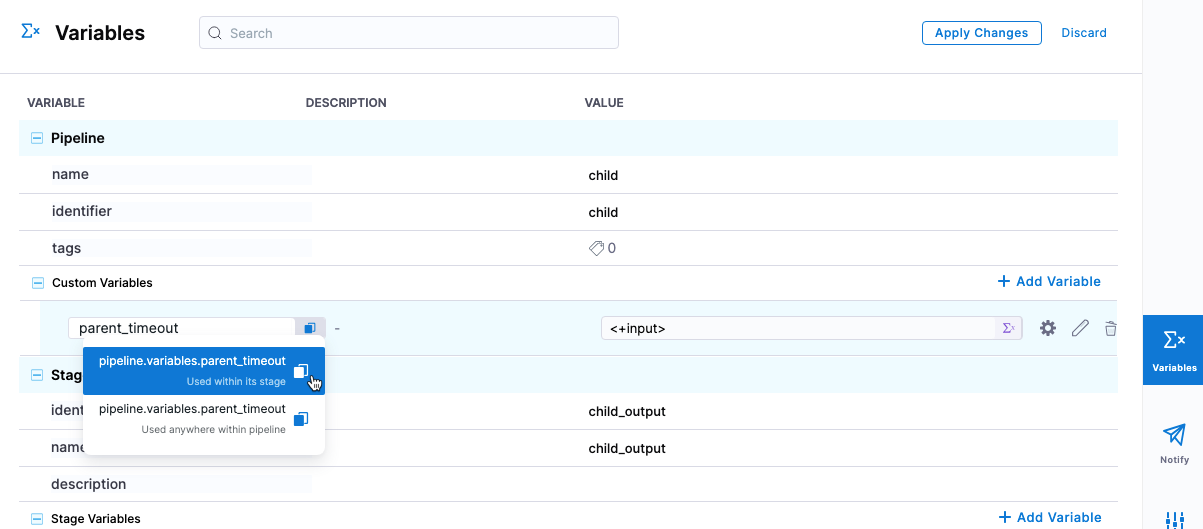
Under Pipeline, in Custom Variables, select Add Variable. You can also utilize variables defined at any stage in the child pipeline.
-
Enter a name for the variable and set its value as a runtime input, and make a note of the variable expression name. Setting this as a runtime input allows the Parent Pipeline to see the variable and define the information within the variable.
-
Select Apply Changes. Save the child pipeline.
-
In the parent pipeline, verify that you have an output variable to pass to the child pipeline. This can be any variable within the parent pipeline. For example, a Shell Script step output variable. Copy the reference to this variable to be used later.
-
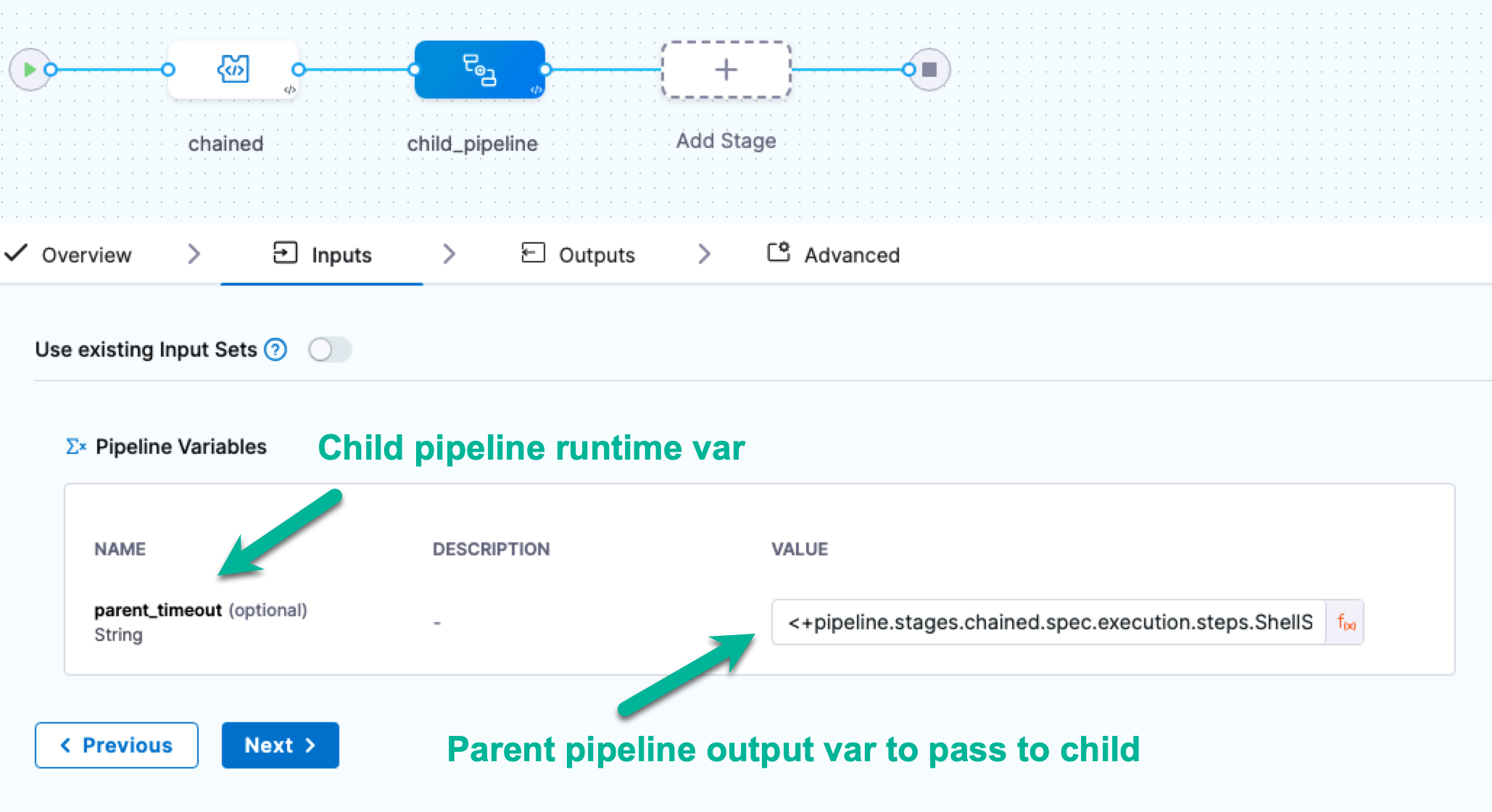
In the parent pipeline, select/add the child pipeline stage. The runtime pipeline variable you added to the child pipeline appears in the Inputs tab, with a runtime input mark.
-
Click on the runtime input mark and change it to an expression.
-
In Inputs, you should see the runtime input from the child pipeline variable you created.
-
In Value, enter an expression that references the parent pipeline output variable you want to pass to the child pipeline, in this case, the reference of the parent pipeline variable from step 5. Save these changes in the parent pipeline.
The Inputs tab supports auto-suggested expressions, but these are not available in the Outputs tab.
When the parent pipeline runs and the child pipeline is executed, the child pipeline uses the pipeline-level runtime variable. That variable is resolved using the value from the parent pipeline output variable.
YAML Example: Chained pipelines using variables
Here's an example of a child and parent pipeline where a parent pipeline output expression is mapped and used in a child pipeline stage.
pipeline:
  name: child
  identifier: child
  projectIdentifier: CD_Docs
  orgIdentifier: default
  tags: {}
  stages:
    - stage:
        name: child_output
        identifier: child_output
        description: ""
        type: Custom
        spec:
          execution:
            steps:
              - step:
                  type: ShellScript
                  name: ShellScript_1
                  identifier: ShellScript_1
                  spec:
                    shell: Bash
                    onDelegate: true
                    source:
                      type: Inline
                      spec:
                        script: echo <+pipeline.variables.parent_timeout>
                    environmentVariables: []
                    outputVariables: []
                  timeout: 10m
          outputs: []
        tags: {}
  variables:
    - name: parent_timeout
      type: String
      description: ""
      required: false
      value: <+input>
Parent pipeline with child pipeline stage
pipeline:
  name: parent
  identifier: parent
  projectIdentifier: CD_Docs
  orgIdentifier: default
  tags: {}
  stages:
    - stage:
        name: chained
        identifier: chained
        description: ""
        type: Custom
        spec:
          execution:
            steps:
              - step:
                  type: ShellScript
                  name: ShellScript_1
                  identifier: ShellScript_1
                  spec:
                    shell: Bash
                    onDelegate: true
                    source:
                      type: Inline
                      spec:
                        script: timeout=<+pipeline.stages.chained.spec.execution.steps.ShellScript_1.timeout>
                    environmentVariables: []
                    outputVariables:
                      - name: parent_timeout
                        type: String
                        value: timeout
                  timeout: 10m
          outputs: []
        tags: {}
    - stage:
        name: child_pipeline
        identifier: child_pipeline
        description: ""
        type: Pipeline
        spec:
          org: default
          pipeline: child
          project: CD_Docs
          outputs: []
          inputs:
            identifier: child
            variables:
              - name: parent_timeout
                type: String
                value: <+pipeline.stages.chained.spec.execution.steps.ShellScript_1.output.outputVariables.parent_timeout>
Re-running Failed Stages in Chained Pipelines
If you re-run the execution from a failed stage, and that stage is configured with a chained pipeline, the entire child pipeline will re-run, not just the specific stage within the child pipeline.
Consider this Pipeline Yaml:-
pipeline:
  name: pipelineA
  identifier: pipelineA
  projectIdentifier: CD_Samples
  orgIdentifier: default
  tags: {}
  stages:
    - stage:
        name: cust_1
        identifier: cust_1
        description: ""
        type: Custom
        spec:
          execution:
            steps:
              - step:
                  type: ShellScript
                  name: ShellScript_1
                  identifier: ShellScript_1
                  spec:
                    shell: Bash
                    executionTarget: {}
                    source:
                      type: Inline
                      spec:
                        script: echo hello
                    environmentVariables: []
                    outputVariables: []
                  timeout: 10m
        tags: {}
    - stage:
        name: cust_2
        identifier: cust_2
        description: ""
        type: Pipeline
        spec:
          org: default
          pipeline: pipelineB
          project: CD_Samples
In this pipeline we are using chained pipeline pipelineB.
Pipeline Yaml for pipelineB:-
pipeline:
  name: pipelineB
  identifier: pipelineB
  projectIdentifier: CD_Samples
  orgIdentifier: default
  tags: {}
  stages:
    - stage:
        name: cust_3
        identifier: cust_3
        description: ""
        type: Custom
        spec:
          execution:
            steps:
              - step:
                  type: ShellScript
                  name: ShellScript_1
                  identifier: ShellScript_1
                  spec:
                    shell: Bash
                    executionTarget: {}
                    source:
                      type: Inline
                      spec:
                        script: echo hello_2
                    environmentVariables: []
                    outputVariables: []
                  timeout: 10m
        tags: {}
    - stage:
        name: cust_4
        identifier: cust_4
        description: ""
        type: Custom
        spec:
          execution:
            steps:
              - step:
                  type: ShellScript
                  name: ShellScript_1
                  identifier: ShellScript_1
                  spec:
                    shell: Bash
                    executionTarget: {}
                    source:
                      type: Inline
                      spec:
                        script: hello
                    environmentVariables: []
                    outputVariables: []
                  timeout: 10m
        tags: {}
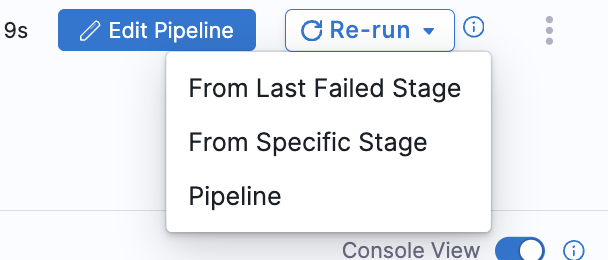
In this pipeline, stage cust_4 will fail due to incorrect shell script command. Now when you click on Re-run and under that From Last failed Stage the whole chained pipeline will run.
Execution of Chained Pipeline
You can see execution of your child pipeline in that pipeline execution history.

Considerations when executing remote chained pipelines
Consider the following points for executing remote (stored in SCM) chained pipelines:
- A chained pipeline is fetched from the default branch when the parent pipeline is defined inline, and the chained pipeline is defined remotely.
- When the parent pipeline is defined remotely, and the chained pipeline is defined inline, the parent pipeline is fetched from the corresponding branch, and the chained pipeline is fetched inline.
- When both the chained pipeline and the parent pipeline are defined remotely, but under the same repository, the chained pipeline should belong to the same branch as the parent pipeline.
- A chained pipeline is fetched from the default branch when both the parent and chained pipelines are defined remotely in separate repositories. This is irrespective of the branch of the parent pipeline.